Once upon a time (so the story goes), the owner of a hotel in a little town named Bakewell asked his cook to make a jam tart. The cook, being rather dim, managed to spread a layer of jam over the pastry shell, and then dollop some kind of eggy almondy mixture on top. "How do you manage to screw up a simple jam tart?" cried the hotel owner. However, being a pragmatic type, he poured some custard on it and sent it out to table 3 anyway. The guests rather liked the new specialité du maison and bingo! the Bakewell pudding was born.
What the story doesn't tell you is that the cook was always doing things like that. "You're supposed to put the fruit on the
top, dammit!" turned into pineapple upside-down cake. "Would you like to explain exactly
why you poured a mug of hot cocoa over a perfectly good chocolate cake?" led to the self-saucing chocolate pudding. But by the third attempt, some genius had hit on the idea of naming the latest bodge-job after the town, and Bakewell's supply of tourist revenue for the next two centuries was guaranteed.
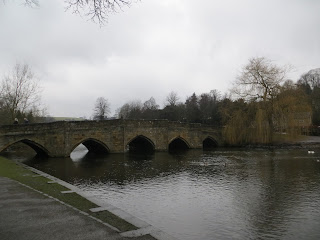 |
| Bridge in Bakewell |
 |
| Bakewell Parish Church |
Believe it or not, I have not yet embarked on cake tourism. My reason for visiting Bakewell, apart from it being a pretty little town in a rather nice part of the Peak District, involved a man by the name of White Watson - but who he is and why I was interested in him will be explained in another blog post. For now, we will gloss over the few hours' research in Bakewell library, and move on to a more interesting part of the trip. Ummm... [leafs through photos] what was that? Oh yes, lunch!
Lunch was eaten in a very English kind of cafe named Byways. The decor made you think you had accidentally wandered into some old lady's sitting room, while the drinks menu reinforced the impression by offering you hot Ribena or Horlicks (or a nice cup of tea, of course). And the baked potatoes were delicious.
Anticipating the cold and drizzly weather, we'd booked a table at the brilliantly named
Baked Well Pottery in the afternoon. A party of excited six-year-olds were being herded out the door as we went in, but after we'd recovered from being trampled, we had the place to ourselves. We settled down for an hour of colourful concentration. Toby and Graham decorated a little turtle while I worked on a small pot.
By the time we found our hotel for the night, the drizzle had turned to snow. In the morning there was quite a thick layer.
However, it was extremely variable; a few miles down the road there was almost none, then all of a sudden it would be everywhere again. The hills had a nice sugar-dusted effect on them.
We attempted some of the Monsal Trail despite the cold. This is a defunct railway line (always good for pushchair walks!) on which they have recently reopened some of the old tunnels. We shivered our way to Headstone tunnel and enjoyed the views from the viaduct beyond, then rushed a crying Toby back to the warm car as fast as possible. The poor kid was cold and tired - never a good combination - but a long nap in the car solved those problems, and let us enjoy a quiet picnic-with-a-view before the drive home.
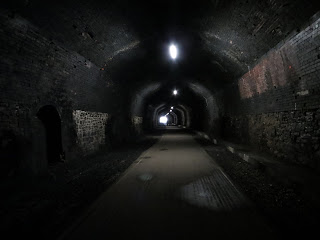 |
| Inside Headstone Tunnel |
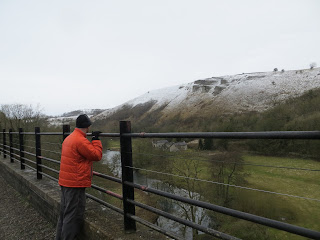 |
| On the viaduct |
Did I say I didn't do cake tourism? Well, it would be rude not to visit even one of those many "Only Original and Authentic Bakewell Pudding" shops, now wouldn't it?
 |
| Very tasty! |


Comments